The alignment step's residual — what can be asserted, and with what¶
The mapping pipeline's build stage measures a solved map's wall rotation,
re-solves with that yaw injected, and — as the design was written — asserts the
residual is under 0.5° or fails the build. Three separate things stop that
assertion being made with angular_stats.wall_rotation, and only one of them is
the ~2° floor its docstring already records.
- The residual is not a single number. On the map the design cites, thirds of the building disagree about where the wall grid is by 8°, and there is a second wall family 18° off the first. No rotation squares the map, so "the residual" is not a property it has to half a degree.
- The primitive does not find the grid.
wall_rotationreports every one of the seven banked 2026-08-02 solves as within 0.3° of square. Four of them are 3.5–5.6° off, which the eye settles in one look. - The injected yaw is not what comes out. The same bag, the same −3.0°
injection, three values of
coarse_angle_resolution: the solved map's orientation moved by +0.1°, −4.3° and −5.8°. A re-solve is not a rigid rotation, so an alignment step must verify after solving rather than assume.
Raw output, the probe that produced it, and the pictures are in
2026-09-01-alignment-residual/.
0. What was measured¶
The seven maps banked by the 2026-08-25 build-params run
(2026-08-25-slam-build-params/): the 2026-08-02 flat bag solved under three
coarse_angle_resolution values, each with and without --frame 0 0 -3.0 —
the birth-alignment injection that produced the shipped map. No bag, no
harness and no GPU are needed to re-check any of this; the maps are in the
repository.
Each map is measured four ways:
angular_stats.wall_rotation |
the primitive the design's alignment step names — FFT, windowed, folded 0/90, sub-bin refined |
room_segmentation.dominant_rotation_deg |
the tree's other FFT estimator, square-padded, 0.5° bins, no refinement |
| projection sweep | rotate the wall mask over ±45° at 0.25°, score Σrow² + Σcol² normalised by wall-pixel count², take the parabolically refined peak |
| projection sweep, per tile | the same, on each ninth of the map |
The projection sweep is not FFT-based and is not a proposal by pedigree: §4 is its validation, and §2 is the check on what it can be asked.
1. There is no orientation lattice¶
The design said, twice, that the live coarse_angle_resolution "snaps
solutions to a ~2° orientation lattice", which is why alignment needed a
build-only 1° one. Karto has no such lattice: ScanMatcher::MatchScan follows
the coarse sweep with a fine pass of half-range
0.5 × coarse_angle_resolution in steps of fine_search_angle_offset,
covering the coarse cell exactly. The reachable angles are a contiguous 0.2°
grid at any coarse value.
Measured and rejected in 2026-08-25-slam-build-params.md §2, which is where
the code excerpt and the drift table live. Nothing here revisits it; the design
text is corrected to match.
2. The residual is not a single number¶
Projection sweep on each ninth of the map, degrees off axis:
unaligned/car-0.0349: whole map +3.46
   -17.15   +2.18   -1.56
   -15.89   +0.37   +4.02
   -15.61   -3.76   +4.48

birth-aligned/car-0.0175: whole map +0.74
   -19.82   -0.24   -3.67
   -18.66   +0.27   +0.42
   -12.86   -6.74   +1.23
The left column is the flat's angled wing — a real second wall family, which the
2026-08-25 report also names as an orthogonal frame 18.5° off the dominant one
carrying 0.16 of the energy. Discard it and the remaining six tiles still spread
8.2° and 8.0°. Whether that spread is architecture or residual SLAM drift cannot
be told from one map — angular_stats' own module docstring makes exactly that
point — and it does not matter here: either way, a 0.5° assertion is being made
about a quantity the artifact does not possess to better than several degrees.
This is the finding that decides the design. It is independent of every estimator: it is the disagreement between parts of the map, not between ways of measuring one.
3. The primitive does not find the grid¶
All seven maps, degrees off axis:
| condition | leg | wall_rotation |
energy_frac |
dominant_rotation_deg |
projection |
|---|---|---|---|---|---|
| unaligned | car-0.0349 | −0.276 | 0.684 | −0.250 | 3.465 |
| unaligned | car-0.0175 | −0.018 | 0.656 | 0.250 | 4.994 |
| unaligned | car-0.01745 | 0.026 | 0.643 | 0.250 | 5.576 |
| birth-aligned | car-0.0349 | −0.092 | 0.680 | 0.250 | 3.568 |
| birth-aligned | car-0.0175 | −0.107 | 0.703 | −0.250 | 0.736 |
| birth-aligned | car-0.01745 | 0.025 | 0.705 | 0.250 | −0.185 |
| birth-aligned | car-0.01745-repeat | 0.025 | 0.705 | 0.250 | −0.185 |
Both FFT estimators call every map square. The sweep calls four of them 3.5° to
5.6° off. The picture is the arbiter — unaligned/car-0.0349 as solved, then
the same map turned by the sweep's −3.465°:
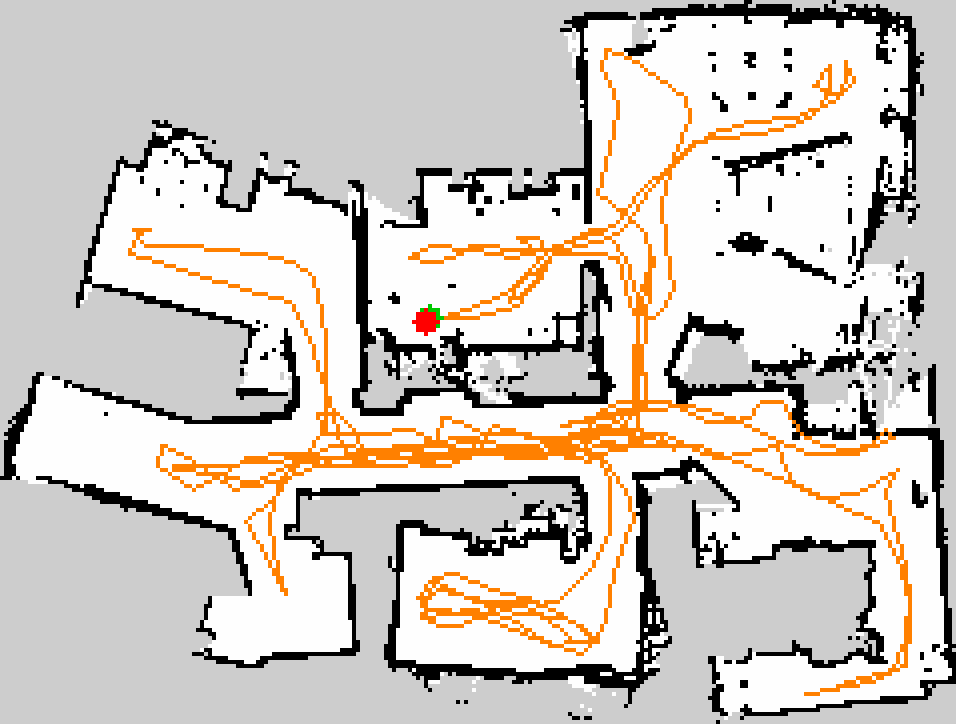
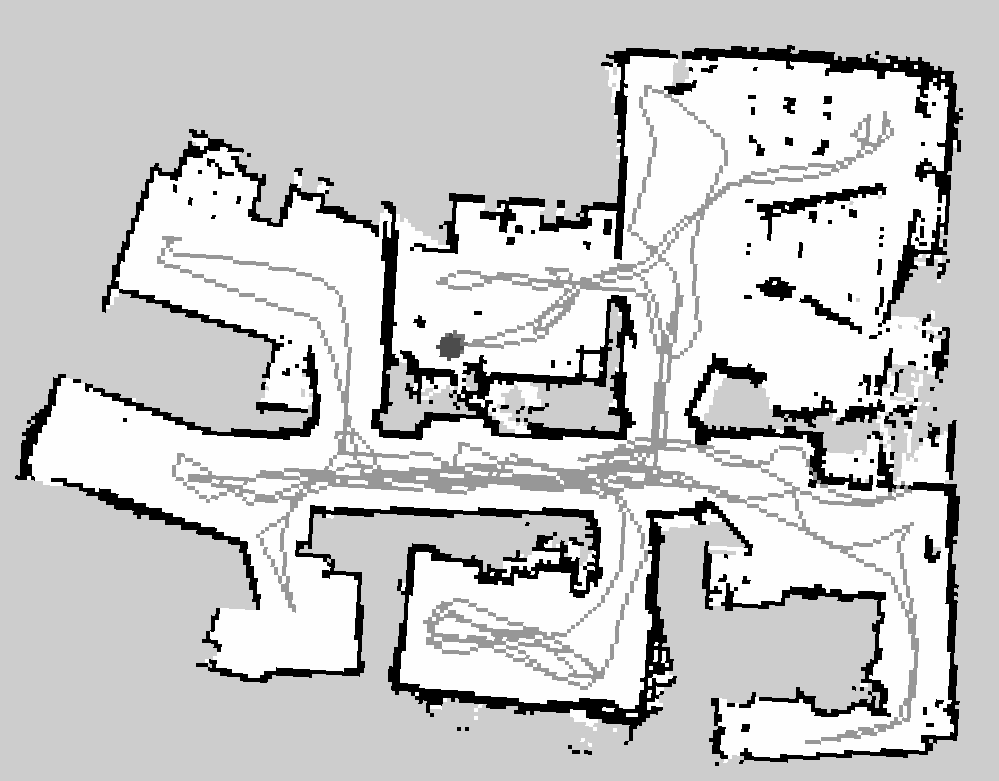
The corridor that ran downhill across the first is level in the second, and the
room boxes square up with it. energy_frac around 0.68 says the primitive
believes it found a dominant grid; there is no low-confidence signal to gate
on.
The shipped revision's meta.yaml records "walls -0.27° off axis", which is the
same primitive answering about the same build — the birth-aligned/car-0.0175
leg reproduces it, matching its recorded loop_drift_m to the digit. The sweep
puts that map at +0.74°. The recorded number sits in the band the primitive
cannot see, so it was never evidence that the alignment worked; the alignment
did work on that leg, and the reason we know is the sweep, not the meta.
Two things worth handing to whoever builds the replacement. The module's other
exported view of the same map — the wall-direction table in the 2026-08-25
report, un-windowed — puts the dominant family at 2.75°, within a degree of the
sweep and 3° from wall_rotation's own answer for that map, so the windowing is
implicated rather than the spectrum. And both FFT estimators were validated
against synthetic single-family room outlines (test_angular_stats.py's
_room_outline); a real occupancy grid with thick walls, furniture, speckle and
two wall families is a different object.
4. …and cannot track a known rotation below 2°¶
Rotate a real map by a known angle and ask each estimator how far it moved.
Base map birth-aligned/car-0.0349; errors in degrees:
| applied | wall_rotation moved |
err | dominant_rotation_deg moved |
err | projection moved | err |
|---|---|---|---|---|---|---|
| 0.25 | 0.107 | −0.143 | 0.500 | 0.250 | 0.276 | 0.026 |
| 0.50 | 0.424 | −0.076 | 0.500 | 0.000 | 0.529 | 0.029 |
| 0.75 | 0.411 | −0.339 | 0.500 | −0.250 | 0.785 | 0.035 |
| 1.00 | 0.700 | −0.300 | 0.500 | −0.500 | 1.011 | 0.011 |
| 1.50 | 1.444 | −0.056 | 2.500 | 1.000 | 1.525 | 0.025 |
| 2.00 | 2.746 | 0.746 | 3.000 | 1.000 | 2.008 | 0.008 |
| 3.00 | 3.168 | 0.168 | 3.500 | 0.500 | 3.023 | 0.023 |
| 5.00 | 5.183 | 0.183 | 6.000 | 1.000 | 5.029 | 0.029 |
| 10.00 | 10.215 | 0.215 | 11.000 | 1.000 | 10.021 | 0.021 |
This reproduces the docstring's floor on real data rather than a synthetic
outline: from 0.25° to 1.5° wall_rotation reports 43% to 96% of the rotation
it was given, then 137% at 2°. Its worst error over the range is 0.75° — one and
a half times the residual the design wanted to assert. The projection sweep's
worst error over the same range is 0.035°.
So a sub-degree residual is measurable differentially, on the map's own pixels, with no new data source: 0.035° is fourteen times inside the 0.5° the design asked for. What is not measurable is an absolute one, for §2's reason.
5. The injected yaw is not what comes out¶
Projection sweep on each pair, against the −3.0° actually injected:
| leg | unaligned | birth-aligned | delta | vs injected |
|---|---|---|---|---|
| car-0.0349 | 3.465 | 3.568 | +0.103 | +3.103 |
| car-0.0175 | 4.994 | 0.736 | −4.259 | −1.259 |
| car-0.01745 | 5.576 | −0.185 | −5.761 | −2.761 |
A rigid pre-multiply on the odometry prior would rotate the whole solve by the
injected amount. It does not, because slam_toolbox's correlation grid is a pixel
grid: starting the map frame 3° elsewhere changes which scan matches are found,
so the injection buys a different solve, not the same one turned. Two of the
three legs came out squarer than they went in; the third — at the live coarse
value — came out no squarer at all, and birth-aligned-squared.png against its
as-solved map shows that leg is still 3.6° off.
That leg is the one that matters for the design. The alignment step ran, the map did not move, and the primitive the step was to be gated on reported −0.092°. The gate would have passed it.
Part of each delta is the sweep's whole-map peak being pulled about by how a solve redistributes structure between wall families (§2), so these numbers are not a solid-body claim about the frame. The direction of the finding survives that: whatever a re-solve does with an injected yaw, it is not "the same map, turned".
What this leaves¶
The alignment step keeps its purpose — a squared map is what room_segmentation
assumes ("Manhattan after rotation") and what an operator reads — and gives up
the absolute assertion. What can be built:
- Measure with a differential estimator. The projection sweep, or anything
that clears §4's table.
wall_rotationcannot carry this; its docstring and the bag-replay README both currently point an alignment step at it. - Gate on improvement, not absence. After the re-solve, the dominant
orientation must be at least as close to axis as before it, by more than the
estimator's own resolution. That gate fails the
car-0.0349leg in §5, which is the failure the design needs caught, and it makes no claim §2 forbids. - Report, do not gate, the rest. The before/after orientations and the tile spread ride on the candidate as review evidence. A building whose thirds disagree by 8° has no squared version, and the operator is the right place for that to land.
docs/design/mapping-pipeline.md is corrected to this, and the estimator itself
is deferred to its own work item — it is a primitive with a validation table,
not a line in an orchestrator.
Limits of this measurement¶
- One bag, one building, and one with an angled wing, which is what makes §2 as stark as it is. A rectilinear warehouse would spread less. It would not make §3, §4 or §5 come out differently: those are properties of the estimators and of the solver, measured on maps of any shape.
- The sweep is validated differentially, not absolutely. §4 shows it tracks
a rotation it is given; its absolute peak is confirmed only by eye
(
unaligned-squared.png) and is soft to the degree the map's own families disagree. That is the right shape for a residual check and the wrong shape for a claim that a map is square. - The applied rotations in §4 are themselves resampled, so every estimator in that table is being read on a re-rasterised map. That is the same rasterisation a freshly solved map presents, so it does not favour one estimator over another.
- §5's deltas mix the frame's rotation with the solve's redistribution and cannot separate them without instrumenting the pose graph.