SfM / Multi-View Depth — Stage 0 Results
Geometry feasibility measured offline from recorded perception bags (issue #21,
plan in sfm_multiview_depth.md "Stage 0"). Harness:
mote_perception/tools/sfm_stage0_geometry.py
— pure geometry over /tf (odom→base), /image_raw/compressed, and the static
camera mount; no depth server, no lidar. Run it on any perception bag:
What was measured
The three quantities the whole triage hinges on, over the ~/.mote/bags/perception
recordings — a mix of autonomous mapping runs and a long parked debug capture:
| bag | duration | path | translating time | frames w/ usable baseline |
|---|---|---|---|---|
20260706_172607 (drive) |
359 s | 19.0 m | 29 % | 26 % |
20260706_135320 (drive) |
215 s | 15.5 m | 41 % | 32 % |
20260630_145232 |
187 s | 3.0 m | 8 % | 11 % |
20260630_111443 |
214 s | ~1 m | 4 % | 6 % |
20260706_133149 (parked) |
1218 s | 0.7 m | 0 % | 0 % |
"Usable baseline" = a past frame exists ≥ 0.10 m away in camera translation with inter-view rotation < 8° reached within a 3 s look-back (in-place turns swing the camera on a short arc but are rejected by the rotation gate, isolating genuine translation parallax).
1. Parallax across the image — adequate when moving
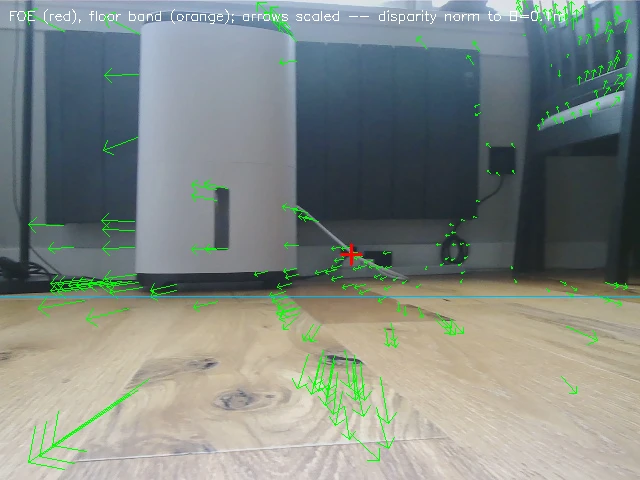
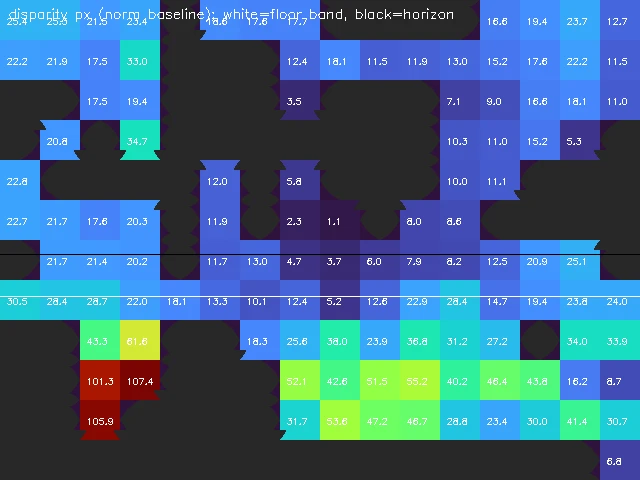
On the best driving bag (135320, 18 tracked keyframe pairs at B ≈ 0.10 m,
disparity normalised to B = 0.10 m):
- Disparity grows radially from the focus of expansion (FOE) exactly as forward-motion geometry predicts: ~4.2 px within 50 px of the FOE, rising to 13–30 px further out. Even the weakest region — the far floor-band edge near the FOE, where upright obstacle marks matter most for planning distance — clears the ~0.5–1 px a matcher needs, and a 0.30 m keyframe baseline triples it.
- The camera's downward pitch keeps the useful 0.25–1.2 m floor band clear of the FOE, confirming the plan's hypothesis that Mote's geometry is more favourable than a generic forward-driving robot.
- The near floor-band edge (x = 0.25 m) projects below the 480-row frame, so the very near floor is not even in view; dense floor matching for the leveling-plane fit would be thin at the bottom regardless.
2. Pose-at-stamp accuracy — not the bottleneck
- v4l2 image stamp jitter is small: header→receipt jitter 2.7–3.8 ms (1σ), which at ~0.2 m/s is only ~1 mm of baseline error.
- odom→base TF publishes at the ~10 Hz lidar rate (100 ms gaps). Leave-one-out interpolation self-consistency (a conservative ~2× -gap bound that also folds in ICP pose noise) is ~1 mm translation, ~0.4° rotation (p90) on translating segments.
- Error budget: the pose/stamp contribution to depth error (
dz|pose-baseline≈ 10–25 mm over 0.5–1.2 m) is comparable to, not dominant over, the matcher-limited error (dz|match≈ 4–21 mm). Stamp error does not dominate the triangulation budget — the plan's primary geometric kill criterion is not tripped. - One caveat: the residual-rotation reprojection upper bound (~2.6–3.4 px) is comparable to the weakest (near-FOE) parallax. It only bites near the FOE and is managed by gating on low inter-view rotation and preferring larger baselines.
3. Usable-baseline duty cycle — the decisive limit
The robot spends most of every mission stopped (42–99 %) or turning in place (1–17 %, zero parallax). Even on the two genuine driving bags it translates only 29–41 % of the time, and only 26–32 % of image frames can reach a usable baseline. A metric multi-view path would therefore produce depth for at most ~1/3 of frames and fall back to the single-image path for the rest.
Verdict
The Stage 0 kill criterion is tripped — but by duty cycle, not by geometry or stamp error. That distinction changes the recommendation versus a flat "kill":
- Stage A — video-depth flicker swap: DO. Motion-independent, works on the always-available single-image path, unaffected by the low duty cycle. The robust win.
- Stage B — sparse triangulated anchors replacing the lidar band: OPTIONAL supplement. Geometry supports it when moving, and it holds anchors while stopped (better than the lidar fit, which needs a constraining scan) — so the low duty cycle hurts it least. Worth a prototype, but not as the primary depth source.
- Stage C — learned-MVS replacement: DEFER. High integration cost to produce metric depth for < 1/3 of frames, still needing the mono path as fallback, is a poor trade until the robot's motion profile changes (or a capable discrete GPU appears).
Net: proceed with Stage A; treat Stage B as an opportunistic decoupling of scale from the lidar rather than a replacement; Stage C stays parked.