Mote
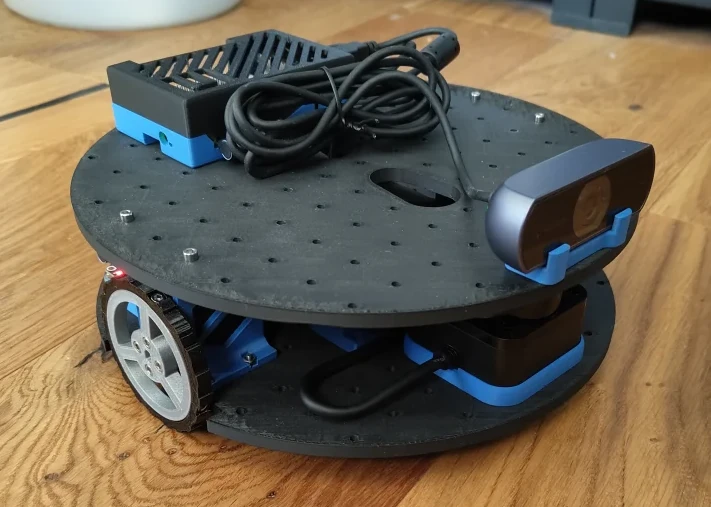
Mote is a differential-drive robot built to be as cheap as it can be while still running a real ROS 2 stack: SLAM, Nav2, a behaviour-tree task layer, a monocular perception pipeline, an SO-101 arm, and a small fleet control plane. The project README says why it exists; this site is the depth behind it.
Everything is managed with pixi — no system ROS install on the Pi or on your workstation.
Start here
- Getting started — prerequisites, build, one-time Pi setup, and your first map and drive.
- Hardware — design decisions, the bill of materials, printing and assembly, wiring and power.
- Simulation — the same launch files against Gazebo, on a world ladder, with no hardware at all.
- Fleet — the operator runbook: overlay, enrollment, dashboard, dispatch, and the map registry.
The stack
| Package | What it does |
|---|---|
mote_bringup |
Launch files, site management, health monitoring, provisioning |
mote_description |
URDF robot model and robot.yaml, the single source of hardware config |
mote_hardware |
The ros2_control interface, and sole owner of the servo bus |
mote_nav |
Nav2 plugins: the wheel-speed critic and the ICP odometry gate |
mote_perception |
Depth and open-vocabulary detection from one cheap webcam |
mote_tasks |
The behaviour-tree task layer — fetch and goto |
mote_arm |
The SO-101 follower arm: calibration, jogging, taught poses |
mote_fleet |
Fleet control plane: server, operator dashboard, map registry |
mote_simulation |
Gazebo sim, a world ladder, benchmarks, and the smoke test |
How the docs are organised
Reference material that belongs to a package lives with that package in the repo, and is copied onto this site at build time — so a page here and the file a contributor edits are never two different documents. The pencil icon at the top of a page opens the file it came from.
Design notes, verification ledgers and tuning runs record why something is the way it is, and what was measured. They are kept rather than rewritten: the fleet architecture note and the verification ledgers beside it are the honest record of what was and was not proven.