M4 verification ledger¶
What was measured for the central site/map registry, how, and what is still
unverified. The interfaces it verifies are fleet-api.md (the
registry routes) and control-plane.md (the retained
…/current topic and health's new map field). The operator flow is
README.md §11.
Everything below was run on the workstation, against a real broker, a real fleet server and a real browser. No run on the Pi or across the tailnet — see §7.
1. The acceptance run: publish → candidate → promote → pull¶
mote_fleet/test/test_e2e_map_registry.py, which is the milestone's acceptance
made executable: a real mosquitto, the real fleet API and its registry, the
publish-map CLI, fleetctl promote, and an agent with a genuine paho client.
The retained half is proved the way it matters — the pulling robot's agent is
started after the promotion, with a different MOTE_HOME, sharing no ROS graph
and no filesystem with the publisher. The only thing that can tell it about the
map is a retained message handed over on connect.
$ pixi run -e dev python -m pytest mote_fleet/test/test_e2e_map_registry.py -q -s
[INFO] [mote_agent]: agent for mote-02 connecting to mqtt://127.0.0.1:38433
[INFO] [mote_agent]: connected to broker as mote-02
[INFO] [mote_agent]: home/ground: fleet canonical map is 20260728T090412, pulling
enrolled as mote-02 (new)
created site 'home' with floor 'ground' at …/puller/sites/home

pulled 20260728T090412 in 0.10s after the agent connected
127.0.0.1 "GET /v1/sites/home/floors/ground/revisions/20260728T090412/bundle.tar.gz" 200
1 passed in 1.25s
(The publish-map and fleetctl promote output earlier in the run is captured
by the test, which asserts on it, so it is not in the tail above; §4 shows the
same two commands' real output against a live stack.)
0.10 s from connect to a published local map on loopback with a small bundle; the transfer itself is what scales with map size, and the announcement that triggers it is delivered at connect, not on a poll interval.
Asserted along the way, in order: the upload is a candidate and the floor's
canonical revision is unchanged (null here — the floor had no map at all); the
floor's zones.yaml travelled inside the revision; the promotion flips and
announces; the second robot ends up with a revision that passes validation, a
resolve_map() that nav2_launch.py would find, the zones from the map's own
frame, and a health payload reporting the revision it is actually running.
2. The shared validator, and the parser that is no longer in it¶
This section originally recorded a hand-rolled YAML parser, differential-tested
against PyYAML on every bundle file committed in the repo, and reported that all
16 agreed. They did. The corpus was not the contract, and review found the
gap: nothing committed here has the shape yaml.safe_dump(default_flow_style=None)
emits for a polygon, which is what segment-map (#69) and save-zone actually
write —
$ python -c "…safe_dump({'zones': {'room_1': {'polygon': [[0,0],[4,0],[4,3]]}}}, default_flow_style=None)"
zones:
  room_1:
    polygon:
    - [0.0, 0.0]
    - [4.0, 0.0]
    - [4.0, 3.0]

$ bundle.read_zones(...)
BundleError: line 6: unexpected indentation
so the path segment a floor into rooms → publish-map was a 422. Two more
divergences from the same writer settings: Matron's office raised, and — the
bad one — a zone named Café came back as Caf\xE9 with no error at all,
because safe_dump escapes non-ASCII and the reader stripped quotes without
unescaping.
The fix is not a better parser. The dependency list the parser existed to
protect was already "python plus paho", PyYAML is the library that writes
these files, and a 200 KB pure wheel is a cheap price for not approximating it.
bundle.py now calls yaml.safe_load; the fleet image installs pyyaml on the
same pip install line as paho; 256 lines went with it.
What replaced the corpus test is the writers themselves — merge_into_zones
from segment-map, append_zone from save-zone, and sites.create — called
for real and read back through the validator:
3. Validation and packing cost, on real maps¶
The occupancy check reads the map with Pillow — see §8; it was a hand-rolled pure-Python decoder until the second review round. Measured on the three committed sim maps, best of three runs, before and after:
| Map | Size | Occupancy decode | Full validate() |
pack() |
Packed | |
|---|---|---|---|---|---|---|
| hand-rolled | Pillow | |||||
mote_world |
117×117 (13.7 k px) | 1.6 ms | 0.1 ms | 0.6 ms | 0.2 ms | 705 B |
office_world |
438×238 (104 k px) | 13.1 ms | 0.2 ms | 0.7 ms | 0.2 ms | 2.9 kB |
hospital_world |
1158×761 (881 k px) | 137.0 ms | 2.4 ms | 3.1 ms | 0.9 ms | 46.5 kB |
57× faster on the largest map, and the answers are identical — the free / occupied / unknown fractions below are the same to six decimal places under both decoders, which is the cross-check that the swap changed no validation outcome.
The fractions the degeneracy check reads: mote_world 0.947 free / 0.043
occupied / 0.010 unknown, office_world 0.899 / 0.050 / 0.051,
hospital_world 0.517 / 0.028 / 0.454 — which is why the "no free space" floor
is set at 0.1%: a legitimate first revision of a big floor is nearly half
unknown, and only a map that never got going has nothing free.
Packing is byte-identical across runs for all three (fixed member order, mode, uid/gid and mtime, and a zeroed gzip mtime). That is what lets the registry announce a digest and then re-pack the stored files to serve it, instead of keeping the uploaded bytes on disk beside the files unpacked from them.
Corrupt is distinguished from unreadable: a PNG that is broken — a bad scanline filter, a header that does not match its data — is what a truncated upload looks like and fails the revision; anything Pillow opens is counted, which now includes the palette and 16-bit images the hand-rolled decoder had to skip. The degeneracy check therefore covers more revisions than it did, not fewer.
The same run also demonstrates the error/warning split on real data: all three
sim revisions validate ok=True with a warning that map.posegraph/map.data
are missing, because sim_home/.gitignore deliberately keeps ~100 MB of
posegraph out of git. Such a revision navigates perfectly and simply cannot be
mapped further — which is a warning to a reader and an error to a publisher.
4. The dashboard, in a real browser¶
A throwaway stack — a container mosquitto on shifted ports (the workstation's
own broker kept 1883/9001), the fleet server with MOTE_FLEET_HOME pointed at a
scratch registry seeded from the committed sim bundles, and one robot's retained
presence/health/pose published straight to the wire — driven with a headless
Chromium.
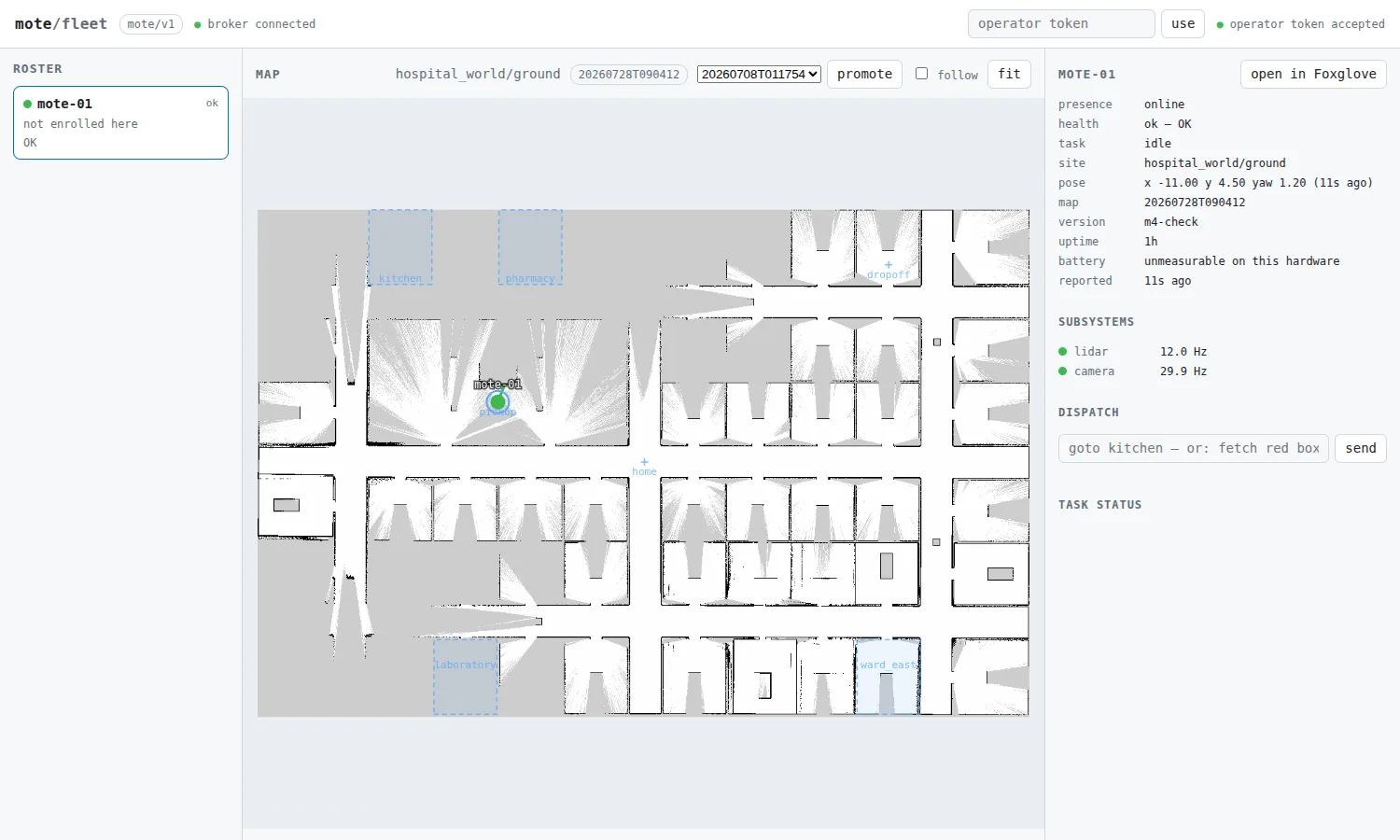
What the picture verifies, none of which a unit test can:
- The floor's zones land on the map. The four dashed rectangles are
hospital_world's ward polygons drawn through the Q5 transform, and they sit exactly on the room walls in the basemap.pickup,homeanddropoffare bare waypoints and draw as labelled crosses. - The canonical revision is on the page (the pill beside the floor name), with a picker of promotable candidates beside it.
- Health's new
mapfield is rendered in the detail pane, so a robot that has not picked up the canonical revision is visible as a difference rather than invisible.
Promotion was then driven from the browser, with the operator token pasted into the page:
$ curl -s .../v1/sites | jq -c '.sites[0] | {canonical, candidates}'
{"canonical":"20260708T000623","candidates":["20260727T101500"]}

$ docker exec mote-m4-broker mosquitto_sub -t 'mote/v1/registry/#' -C 1
{"schema":1,"site":"office_world","floor":"ground","revision":"20260708T000623",
 "url":"/v1/sites/office_world/floors/ground/revisions/20260708T000623/bundle.tar.gz",
 "sha256":"sha256:7748c15c…","bytes":2878,"promoted_by":"michael",
 "stamp":"2026-07-27T22:37:12.454Z"}

$ fleetctl audit --limit 3
WHEN                  WHO            ROBOT      RESULT       COMMAND
2026-07-27T22:37:12Z  michael                   promoted     office_world/ground/20260708T000623
The flip, the retained announcement carrying the digest, and the audit row naming the operator — from a click.
5. What the test suite covers¶
$ pixi run -e dev python -m pytest mote_fleet/test mote_bringup/test/test_bundle.py \
      mote_tasks/test -q
265 passed in 84.40s
$ pixi run -e dev node --test mote_fleet/test/ui_test.mjs
# pass 16
The M4 half of that: test_bundle.py (43 — what the real writers emit, the
validator's refusals, the PNG decoder's two corruption cases, and the tar's
refusals including a hand-built hostile archive), test_map_registry.py
(28 — every registry route over a real socket), test_mapsync.py (13 — the
robot's staging, flip, zone adoption and digest check against a live server, no
ROS), seven added to test_agent.py (subscribe, route, pull, ignore, report),
five to test_protocol.py, three to ui_test.mjs, one to mote_tasks'
test_zones.py (save-zone's output, read back through the validator that has to
accept it), and the e2e run in §1.
6. Deltas from the design sketch¶
Five things landed differently from fleet.md Q4, each for
a reason:
- The retained topic is
mote/v1/registry/site/<site>/floor/<floor>/current, notmote/registry/…. The major version belongs in the topic root for the same reason it does everywhere else in the tree, and puttingregistryat the robot-id level meansregistrymust be reserved — which it now is, inprotocol.valid_idand inparse_topic. - The shared validator lives in
mote_bringup, not inmote_fleet. The bundle layout issites.py's, andmote_fleetalready depends onmote_bringup; the other direction would be a package cycle. The deploy image copies the two ROS-free files (__init__.py,bundle.py) besidemote_fleet/protocol.py, so the fleet box still installs no ROS. - Uploads are not operator-authenticated. The design does not say who may
upload; making it an operator credential would mean pasting one onto every
robot. Instead an upload must name an enrolled robot, is bounded, is
audited, and — decisively — is inert: it changes no floor. The write that
changes something is the operator's promote. M7 replaces the
robot_idcheck with a per-robot credential. - The flip and the announcement are reported separately. A broker that is
down must not leave a floor half-promoted, so the symlink flip stands and the
response says
announced: false. The fleet server re-announces every floor from the filesystem at startup, which repairs both that case and a broker that lost its retained state with its volume. - Zones travel inside the revision, and replace the floor's on install (the
old file is kept as
zones.<old-rev>.yaml). The design says map and zones must travel together; the consequence nobody writes down is that installing a different session's map makes the previously bound zones wrong, so leaving them in place would be the silent failure the rule exists to prevent.
Also worth recording: save-map now runs the same validation locally, so a map
the server would refuse is refused on the robot while the mapping session is
still up.
7. Not verified¶
- No Pi, no tailnet. Everything here is loopback on the workstation. The
transfer size that matters on a real robot is the posegraph, which is tens
of MB and is not in any of these runs (the sim bundles exclude it from git, and
the e2e test's is a stub). A real
publish-mapover the tailnet is the first thing to measure on hardware. - Nav2 does not hot-reload a flipped map.
map_serverreads its map at startup, so a pulled revision takes effect on the next bringup. The agent logs it and health reports the running revision, which makes the gap visible; making the flip take effect live is not in this milestone. - No concurrency test on promote. Two operators promoting different
revisions of one floor at the same instant is
os.replaceracing itself — last writer wins, both are audited, and neither leaves a broken symlink, but that is reasoned rather than measured. - Pruning is only unit-tested; no long-running box has actually aged out a revision.
- The
-2id qualifier is tested, not observed in the wild. It needs two robots saving maps in the same second, which is exactly the case that will not show up until M6.
8. What review found, and what changed¶
Five findings on the first pass (PR #70), all reproduced by execution rather than read off the diff. What each one turned into:
segment-map's output was a bundle this branch refused (blocking). The subject of §2: fixed by deleting the hand-rolled parser rather than extending it. The replacement tests call the real writers, because the original ones only ever saw files that happened to be committed.- ~400 lines re-implementing PyYAML and a PNG reader. Half taken: PyYAML is in, the PNG decoder stays, and §3 says why the two are not the same call.
validate()broke its own "never raises" contract (blocking)._unfilterraisedBundleErroron an unknown scanline filter, which no caller on the upload path caught: the client sawRemoteDisconnectedwith no HTTP status, and because the handler died betweenregistry.recordandregistry.finish, the audit row stayed atreceivingfor ever. Three changes: the decoder reports every failure and never raises;bundle_store.accepttreats a validator that raises anyway as a 422; and the upload handler closes its audit row on any exception, so no row can be wedged mid-transfer by a bug that has not been thought of yet. The corrupt/unsupported split in §3 came out of this — a bad filter byte now fails the revision instead of merely skipping the occupancy check.- Unbounded
zlib.decompresson the upload path. IHDR is parsed before the inflate, so the bound was free:
$ # a 64 KB PNG whose header declares it 1x1, carrying 64 MB compressed
bomb PNG on disk: 65295 bytes, declares itself 1x1, inflates to 67108864 bytes
occupancy() -> {'reason': 'image data is larger than its dimensions allow',
                'corrupt': True}
0.2 ms, peak RSS 67 MB (unchanged across the call)
Before: 786 MB of RSS for a 261 KB upload, which at the 64 MB MAX_UPLOAD
scaled to ~64 GB. Also from this finding: a map that already failed the
MAX_EXTENT_M sanity check no longer gets decoded pixel-by-pixel afterwards.
5. The fleet image would not rebuild for its own validator. fleet-image.yml
triggered on five paths; the Dockerfile COPYs eight. bundle.py,
bundle_store.py and server/ui/** added, with a comment saying the two
lists have to agree.
Second round¶
A further review (Fable) found one merge-blocking defect and five smaller ones. All are fixed here.
- The fleet image did not build.
.dockerignoreis a deny-all allowlist whose own comment says "adding a COPY means adding a line here", and this branch added three COPYs without adding the lines:"/mote_fleet/server/bundle_store.py": not found. The irony is exact — §5 of the first round found the sibling bug (the workflow's trigger paths out of step with the Dockerfile) and fixed that list while missing the third list that has to agree. There were three hand-synced lists; the PR itself proved the failure mode. Now: the allowlist is fixed, andfleet-image.ymlbuilds on pull requests touching those paths (without pushing), which is the check that would have caught it. Verified by building the image here — 152 MB, andbundle,PIL,yamlandpahoall import inside it. - The PNG decoder is gone, replaced by Pillow (§3). It was the last
hand-rolled reader, and the last thing standing on the invented "stdlib-only"
rule. This also cost a correction:
pillowwas not already in the robot env — it is declared only under[feature.inference*], and the robot's image library is opencv — so this adds a dependency to the default env as well as the fleet image. announce_allwas one-shot. It runs on a daemon thread at startup "because the broker may be starting alongside us", but a failed publish broke the loop and left every retained topic stale until the next restart — the opposite of the self-repair it exists for. Now retries with backoff (~2 min) and treats a raising publisher the same as a refusing one, since on a daemon thread an exception is a silent death.describe()re-validated every revision on every read, including the full pixel decode, on a route the dashboard hits at every floor switch. Now reuses the report stored at upload while the directory'smtimeis unchanged;promotestill always re-validates, so the claim that gates publishing is never a cached one.- Upload staging directories were listed and prunable.
mkdtempstages insidemaps/, andrevisions()returned every directory — so a read could see half a bundle and one upload's prune could delete another's in-flight work.revisions()now skips dot-directories. - Two cosmetic fixes: a copy-pasted 500 message in
_promotethat talked about uploads, and apixi.tomlcomment pointing atdocs/fleet/registry.md, which does not exist.
Also corrected in this round, and worth recording because it is the same mistake in a different place: the image-size claims. Comments said "tens of megabytes"; the built image measures 152 MB.
Not changed: the -2 revision qualifier, the promote race, and pruning are all
still reasoned rather than measured (§7).